Industrial Recycling in Australia: Waste Streams, Processing, Equipment, Approvals, and Outputs
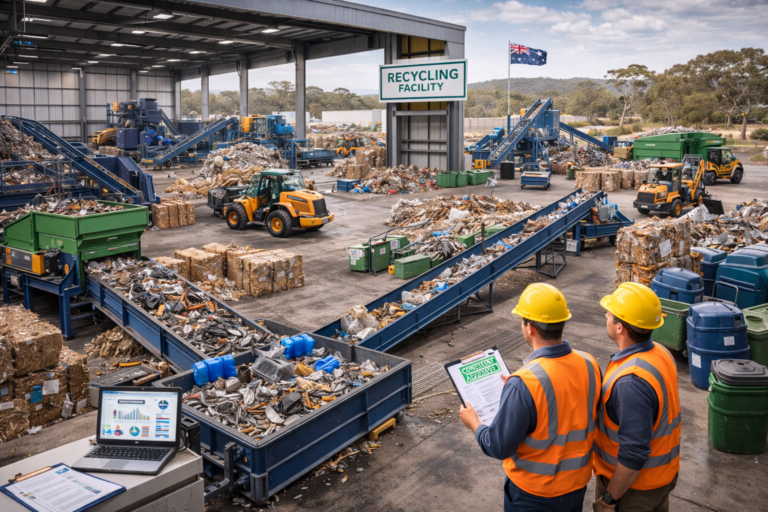
It doesn’t matter if you are into construction, food processing, or retail; as a business owner in Australia, you’ve probably thought about this question that we throw away a lot, but how much of it actually needs to go to landfill? To give you an honest answer, not as much as you think. Most of it can be recycled, processed, and put back to use. But what is preventing your facility from doing recycling is not having the right system, knowledge, and process for your site. That is why we have this guide: to walk you through industrial recycling, from waste streams and equipment to approvals and outputs!
Key Takeaways
|
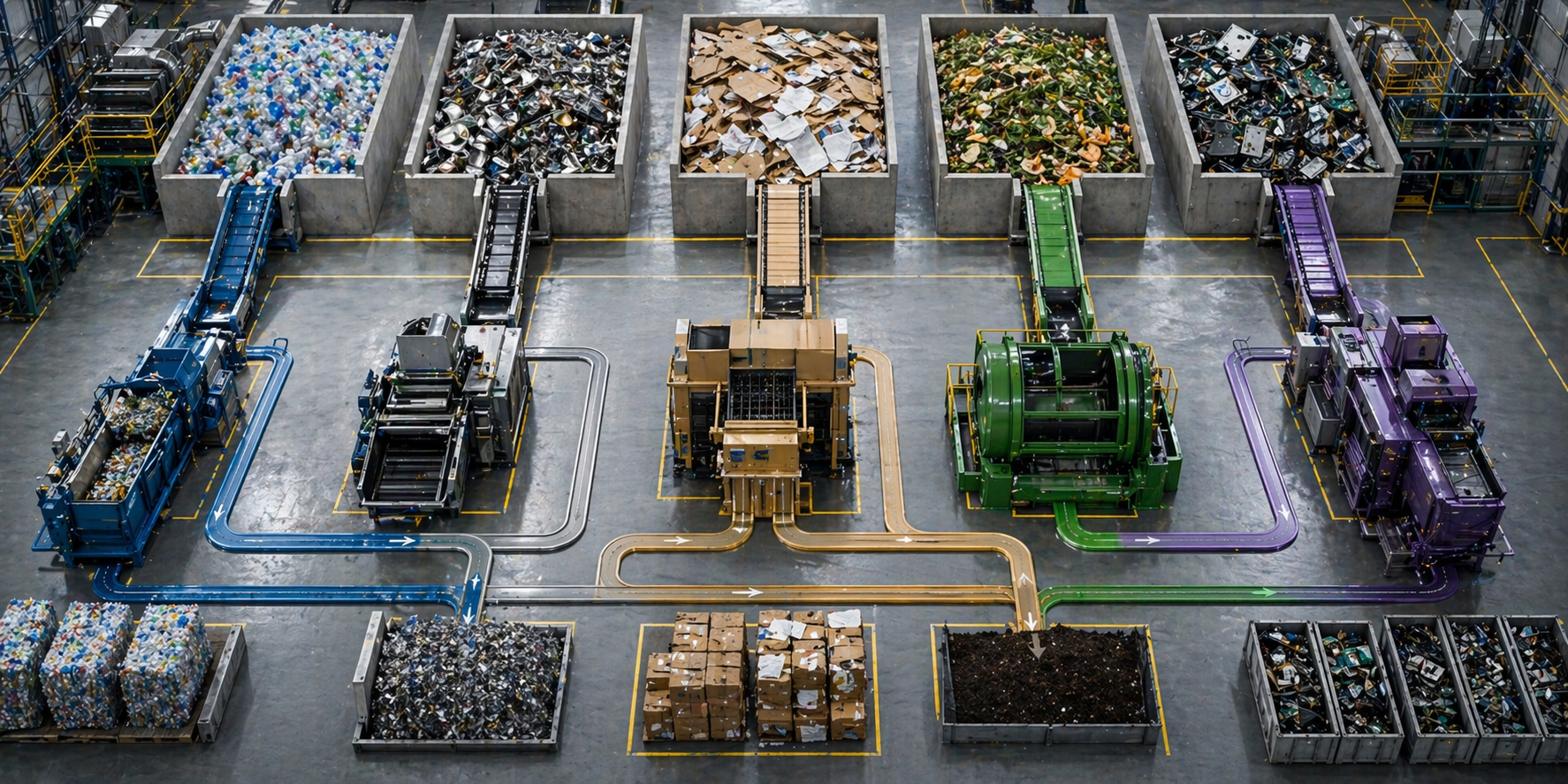
How does a recycling facility work step by step?
Receiving and Checking
A truck comes into the recycling facility carrying waste.
- First, it is weighed.
- Then, workers look at the waste to check whether there’s anything prohibited.
- After checking, they sort the waste into categories like plastic, metal, etc.
- Finally, the truck is told where to unload inside the facility.
If you want a deeper understanding of how waste is classified at this stage, you can read our blog on different industrial waste streams.
Pre-sorting and Contamination Control
Before material enters the main processing line, manual or mechanical pre-sorting removes large contaminants like:
- Timber
- Metals
- Non-recyclables
This stage is especially critical when dealing with complex waste types like construction debris. If you want to explore this in detail, you can read our blog on the construction and demolition waste management challenge.
Size Reduction and Material Conditioning
With the help of:
- Shredders
- Granulators
- Hammer mills
The feedstock is reduced to a consistent particle size. Uniform sizing is needed as it determines how accurately downstream screens, air classifiers, and optical sorters can separate material by type and composition.
Sorting and Separation Stages
All the material moves through a sequence of separation technologies, such as:
- Trommels
- Vibrating screens
- Magnetic and eddy current separators
- Near-infrared optical sorters
Modern recycling facilities are increasingly driven by automation and smart systems, so if you’re interested, explore our blog on technological advancements in recycling.
Output Quality Control and Product Specs
Then the sorted fractions are tested against contractual product specifications before being:
- Baled
- Stockpiled
- Dispatched
Whereas the off-spec material is either:
- Reprocessed
- Blended down
- Redirected as residual
depending on the offtake agreement and contamination threshold in place.
Residuals and Landfill Diversion Improvement
So, after recycling, some waste is left over. Instead of throwing it in a landfill, workers look for other ways to use it:
- Either turn it into fuel
- Use it to fill land like construction sites
They also keep checking numbers to see:
- How much waste is being saved from landfills
- Where can they do better next time
This shift is part of a broader industry movement, so learn more in our article on the future of waste and recycling solutions.
Which Recycling Solution Fits Each Waste Stream in Australia?
Mixed Recyclables in an MRF (sorting co-mingled material)
A Materials Recovery Facility sorts co-mingled kerbside and commercial recyclables using a combination of mechanical screening, optical sorting, and magnetic separation. The outputs include baled paper, cardboard, plastics by polymer type, aluminium, and steel, each targeted at specific commodity markets.
Fibre Streams (paper and cardboard) and How They’re Prepared
Paper and cardboard are pre-sorted through manual sort lines and conveyor systems, then compacted using horizontal balers to meet paper mill specifications. Different types, like mixed paper, cardboard boxes, and newspapers, are separated because each has a different value.
Glass Recovery and Cullet Quality Control
Glass is collected and sorted using machines like optical sorters that can tell the difference between colors like clear, brown, and green. This is important because well-sorted glass can be reused to make new glass products. If it’s not sorted properly, it gets used for lower-value things like building roads or filling construction areas.
Plastics Sorting and Preparation for Secondary Processing
These are sorted using near-infrared (NIR) optical sorters that separate them by type, like PET, HDPE, etc. Then, they are either packed or broken down into small pieces for reuse. If plastic is mixed with labels, glue, or other types of plastic, it reduces its quality and value. That’s why cleaning and proper sorting are very important.
Organics and FOGO Processing with Contamination Management
All the food organics and garden organics (FOGO) are processed through composting, anaerobic digestion, or in-vessel systems. Contamination, particularly plastics and metals, must be mechanically screened before or after biological processing to meet the Australian Standard AS 4454 for compost product quality.
Textile Sorting and Pre-processing Pathways
Textiles are manually graded into re-use or industrial wiping cloth categories using sorting conveyors. After sorting, they are packed and sent for recycling. If the textiles are made of mixed synthetic materials, they are sent for special recycling processes like heating or chemical treatment.
End-of-life Tyre Processing and Material Recovery Outputs
Old tyres are processed using primary and secondary shredders, followed by granulators and magnetic separators to recover rubber, steel wire, and fibre. For a deeper look into how this works operationally, you can check our blog on tyre shredding streamlines industrial waste management.
Skip Bin and Mixed C&D/C&I Loads
Construction and demolition (C&D) and commercial and industrial (C&I) mixed loads are processed through trommel screens and manual sort lines to recover timber, concrete, and masonry. Fines below 20mm are typically directed for reuse in construction or sent to landfill, depending on how clean they are. This explains the C&I and C&D recycling importance.
Residual-to-fuel Pathways
High-calorific residuals such as plastics, timber, textiles, and non-recyclable paper can be processed using densifiers/pelletisers to produce Refuse-Derived Fuel (RDF), Process-Engineered Fuel (PEF), or Solid Recovered Fuel (SRF). These fuels substitute for coal and gas in cement kilns and industrial boilers, reducing waste in landfill while generating measurable carbon savings.
If you want a broader understanding of how different materials are processed across industries, you can also read our blog on industrial waste recycling: types and methods.
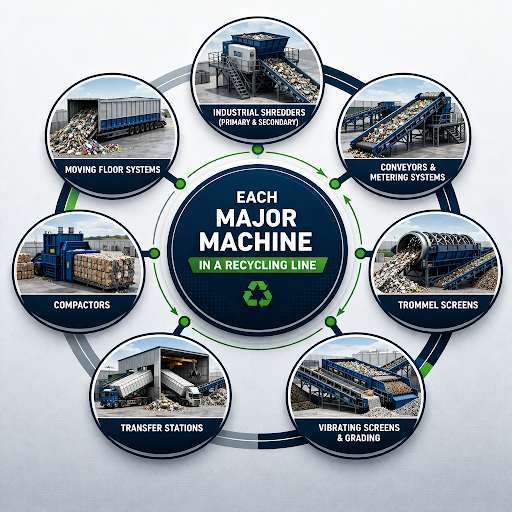
What Does Each Major Machine Do in a Recycling Line?
Industrial Shredders (primary and secondary)
- Primary: Primary shredders reduce bulk waste to a coarse fraction suitable for downstream screening.
- Secondary: Secondary shredders refine particle size further for optical sorting or fuel preparation.
Also, the shredder selection, be it single-shaft, dual-shaft, or slow-speed, depends on:
- Feedstock hardness
- Throughput rate
If you want to understand more about how different shredders work and which one suits your waste type, check our blog on industrial shredder types.
Conveyors and Metering Systems
Conveyor systems have been revolutionising waste management for a long time. In this, the belt and chain conveyors move material between processing stages at controlled feed rates. On the other hand, metering systems, like belt feeders or reciprocating plate feeders:
- Control the volume entering each processing unit
- Preventing surges that cause blockages
Trommel Screens and Size Separation
A trommel screen is a big rotating drum with holes in it that separates materials based on their size. As the drum spins, small particles like:
- Dirt
- Tiny glass pieces
fall through the holes, the medium-sized recyclables come out separately, and the large pieces stay inside and exit at the end. In C&D and FOGO recycling, trommels are usually the first mechanical step, helping remove soil and fines so the remaining materials can be processed more easily.
Vibrating Screens and Grading
Vibrating flat-deck or inclined screens divide material into point-size fractions for downstream sorting accuracy. Unlike trommels, they produce sharper size cuts and are preferred where tight grading tolerances are required, particularly in glass cullet processing.
Transfer Stations and Receiving Infrastructure
To move heavy waste between transfer stations and processing sites, the:
- Walking floor trailers
- Hook-lift containers
- Compactor-body trucks
are used. Also, choosing the right type of trailer is important because it affects how much waste can be carried per trip, whether it works with the unloading equipment, and the cost to transport each tonne.
Compactors
Once material is sorted, compactors and balers compress it into dense, stackable bales, making it easier and cheaper to store and transport. Choosing the right compactor bin for your industry is important, because without this step:
- Sorted paper
- Cardboard
- Plastics
take up too much space to move efficiently.
Moving Floor Systems and Controlled Unloading
A moving floor system is a mechanised floor built into:
- Trailer, or
- Receiving bunker
It pushes material out gradually and evenly without the vehicle needing to tip. In a recycling line, this matters because it controls exactly how much material enters the shredder or processing equipment at a time.
How Recycling Projects are Delivered in Australia
Waste Audit and Mass Balance Development
Before anything is designed or purchased, you need to understand exactly:
- What a waste you are working with?
- How much of it?
- What is in it?
This audit becomes the foundation for every decision that follows, from which equipment to buy to what your facility can recover and sell.
Process Design and Layout Planning
Once you know your waste, you design the process around it. This means deciding on:
- Which equipment goes where?
- How do trucks move through the site?
- Where is sorted material stockpiled?
Procurement, Fabrication, and Installation Sequencing
The equipment that goes into a recycling facility does not arrive overnight. All the:
- Shredders
- Optical sorters
- Screening systems
which are being imported into Australia, can take anywhere from 16 to 40 weeks to arrive. So make sure procurement is planned around your construction timeline.
Commissioning, Performance testing, and Handover
Once the plant is built and the equipment is installed, it does not just switch on and run at full capacity. Commissioning happens in stages:
- First running the equipment dry
- Then with material
- Then, pushing it to its agreed throughput targets.
Operator Training, Spares, and Maintenance Planning
A facility that runs well on day one but falls apart by month six is a failed project. Thats is why before handover:
- Operators need hands-on training
- The site needs a maintenance schedule, and
- Stock of critical spare parts on hand
This is what keeps the plant running properly once the project team walks away.
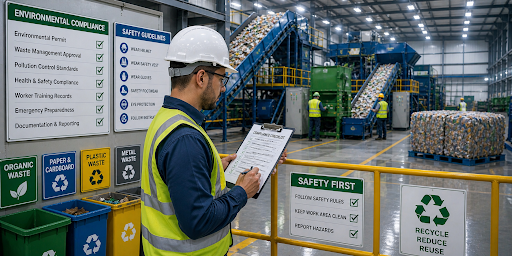
What Approvals And Compliance Typically Apply to Recycling Facilities in Australia?
Environmental Approvals and Operating Licences (state regulators)
All of the commercial recycling and waste processing facilities in Australia require an environmental protection licence or equivalent approval from the relevant state regulator. These licences set conditions around emissions, groundwater, fire management, and permitted waste types. Key requirements typically include:
- Environment Protection Licence (EPL): NSW Environment Protection Authority (EPA).
- Works Approval and Licence: WA Department of Water and Environmental Regulation (DWER).
- Environmental Authority: Queensland Department of Environment and Science (DES).
- Works Approval/Licence: SA Environment Protection Authority.
- Environment Protection Licence: Victorian Environment Protection Authority (EPA Victoria).
Planning and Development Approvals (local councils)
A development application (DA) or planning permit is required from the relevant local council or state planning authority before any recycling facility can be constructed or expanded. Planning considerations include:
- Land use zoning and permissibility for waste management land uses
- Traffic and transport impact assessments.
- Acoustic, odour, and visual amenity reports.
- Fire safety and emergency management provisions, which are often required at the DA stage, particularly for high-risk waste streams.
Work Health and Safety Obligations for Plant and Operations (WHS framework)
Recycling facilities are classified as high-risk work environments under Australian WHS legislation. The model Work Health and Safety Act, adopted across most Australian jurisdictions, imposes specific duties on persons who are conducting a business to eliminate or minimise risks to workers. Key obligations include:
- Safe design registration for plant and equipment above specified thresholds.
- Hazardous manual tasks risk assessments.
- Dust, noise, and vibration monitoring programs.
National Waste Policy Signals that Influence Infrastructure Investment
Australia’s National Waste Policy: Less Waste, More Resources (2018) and its associated action plan set the strategic direction for investment in waste and resource recovery infrastructure across all levels of government. Key policy signals that affect recycling facility investment decisions include:
- The 2030 target is to halve the amount of organic waste sent to landfill, thereby driving investment in FOGO and organics processing.
- The phased ban on unprocessed waste exports, particularly for mixed plastics, paper, glass, and tyres.
- The Recycling Modernisation Fund (RMF), which has co-funded infrastructure capable of processing material that was previously exported.
How To Improve Output Quality, Safety, And Uptime in Resource Recovery Facilities?
Contamination Reduction Systems and Protocols
When contaminated loads are accepted at the gate without being checked, that problem travels through your entire processing line and ends up in your output, which your buyers will reject. Make sure to check loads on the way in, and turn away anything that does not meet your standards.
Fire Risk Controls for High-Risk Waste Streams
It is well obvious that facilities carry a real fire risk, like lithium-ion batteries hidden in general waste, stockpiles of plastics and tyres sitting in the yard. Always have systems in place that can detect batteries on the way in, control how high and how close stockpiles are stored, and ensure your fire suppression system is designed for your specific materials.
Dust, Noise, and Odour Controls
Processing waste will generate dust, noise, and in some cases strong odours. The environmental licence will set limits on all three, and if you breach them, your regulator will come knocking. So keep in mind all of this, as you wouldn’t have to deal with complaints, council notices, and licence variation requests.
Wear Management, Maintenance Cadence, and Critical Spares
You wouldn’t wait until something breaks to fix it, right, because you lose production time and money every time it happens. So, to prevent shredder blades from wearing down or conveyor belts from cracking, conduct regular maintenance and keep spare parts on hand.
Reporting and Traceability for Compliance and Offtake
Your environmental licence requires you to report what comes in, what gets processed, and what goes out by material type. On top of that, the businesses buying your recovered material will want proof of where it came from and what condition it is in. Keeping basic digital systems in place to track loads and outputs makes both of these things simple.
How To Choose The Right Recycling System for Your Site: A Buyer’s Checklist?
Define Feedstock, Volumes, and Contamination Rate
Start with what you know about your waste streams, like:
- How many tonnes per day?
- What materials are in the mix
- How much moisture content
- Bulk density
- Contamination percentage
If you do not have this data yet, get a waste audit done first. As every equipment decision flows from this.
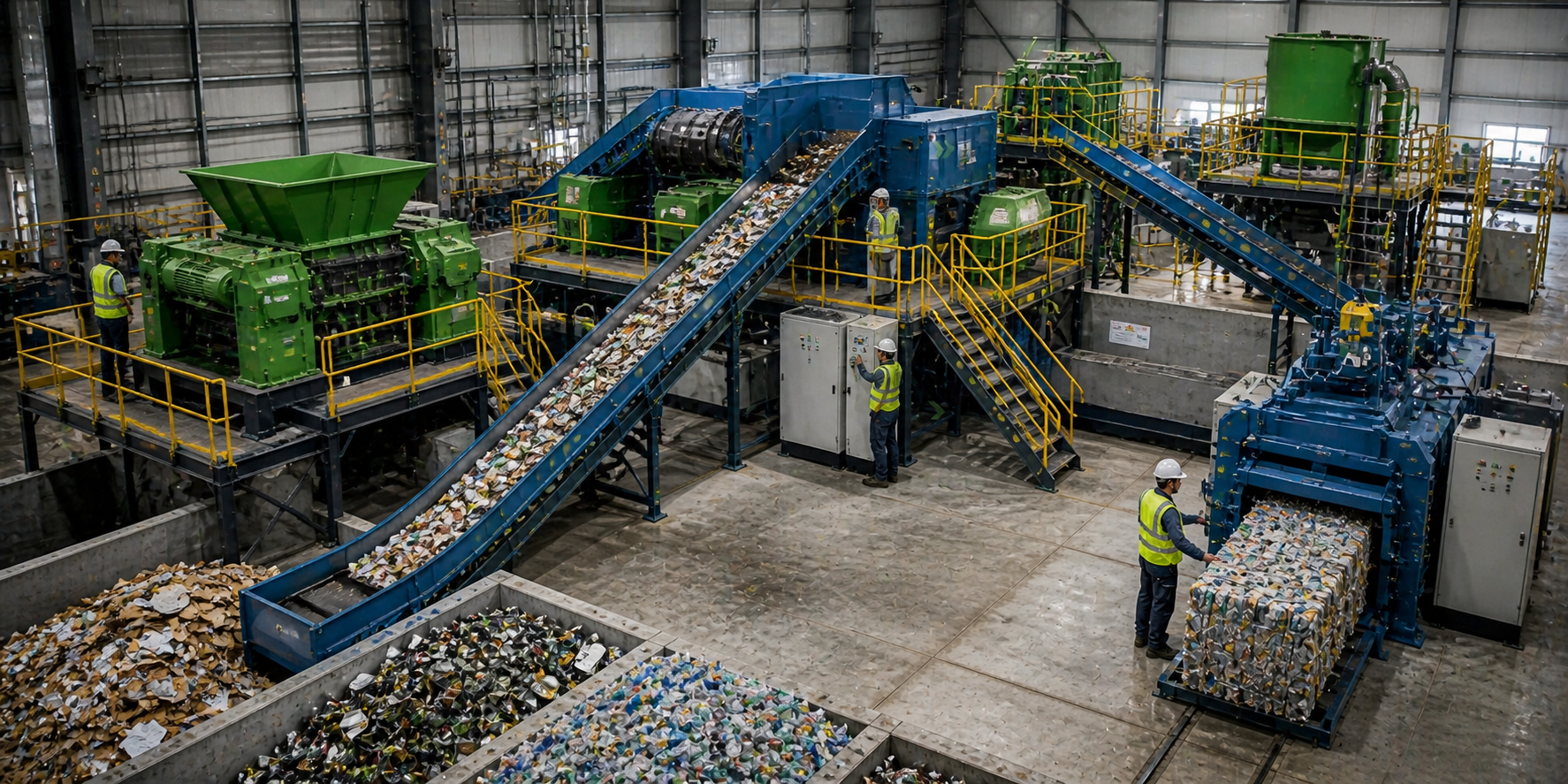
Define Outputs and End-market Requirements First
Before you design anything, get clear on where your recovered material is actually going and what condition it needs to be in when it gets there. The specifications your end markets require are:
- Bale density
- Moisture levels
- Particle size
Therefore, these should drive your equipment decisions, not the other way around.
Match Equipment to Footprint, Power, Labour, and Automation
The best equipment on paper means nothing if it does not fit your site. Be realistic about:
- How much floor space do you have?
- What power supply is available?
- How much automation can your operation actually support and maintain day-to-day?
Build the Business Case
Now, before you commit to any system, model the full numbers, like:
- What it costs to buy and install
- What you will earn from recovered material
- What you will still spend on disposing of residuals.
Plan Approvals Early and Build a Commissioning Timeline
Do not leave approvals until after you have chosen your equipment or signed contracts. Environmental licences and development approvals in Australia can take quite a long time. So, the earlier you start that process, the less likely it is to delay your entire project.
Conclusion
Thus, organisations that invest in properly designed, approved, and operationally sound resource recovery infrastructure will be more competitively positioned in the markets. If you are looking for a partner who understands recycling infrastructure from the ground up, OGTEC is exactly that. With more than 15 years of experience in the industry, we handle it all, from design to installation.
FAQs
If I have a small business, do I still need a licence to operate a recycling facility?
Yes, any commercial waste processing operation, regardless of size, requires the relevant state environmental licence to operate.
How does fire at a recycling facility affect the operating licence in Australia?
A fire typically triggers a regulatory investigation and may result in licence suspension until a satisfactory fire management plan is resubmitted.
Does my business need to comply with Australia’s waste export ban?
Yes, any business that generates, collects, or processes glass, paper, plastics, or tyres at scale is directly affected by the ban.
How do I classify industrial waste correctly in Australia?
Each state uses its own waste classification framework, like general, prescribed, or hazardous, based on composition and risk.
Is it actually cheaper to recycle industrial waste than send it to a landfill in Australia?
Generally, recycling can be cheaper if the waste is properly sorted, as landfill taxes rise.