Improving Recycling Efficiency with Advanced Glass Processing Machines

As glass is one of the few materials that can be recycled endlessly without losing quality, global recycling performance is still far from its potential. As per a report published in Environmental Engineering Research (EER), around 130 million tons of glass are produced worldwide each year, but only about 27 million tons are recycled, leaving the global recycling rate near 21%. The potential reasons behind this are poor collection systems, mixed waste contamination, inefficient sorting, and limited access to advanced recycling facilities. This is exactly where advanced glass recycling equipment can make a major difference by improving recovery rates, quality, and recycling efficiency.
And now you must be wondering how? Well, through this blog, we will explore how using advanced processing lines helps to streamline the entire workflow from start to finish.
Advanced Glass Processing: A Technical OverviewAutomated recycling technology transforms abrasive glass waste into high-purity cullet by replacing inefficient manual sorting with precision engineering. Through integrated stages of mechanical crushing, multi-motion screening, and hydraulic washing, these systems eliminate critical contaminants like ceramics and stones. Utilising AI-driven optical sensors and thermal drying, the process maximises material recovery and furnace energy efficiency, reducing carbon emissions and securing sustainable, furnace-ready resources for the circular economy. |
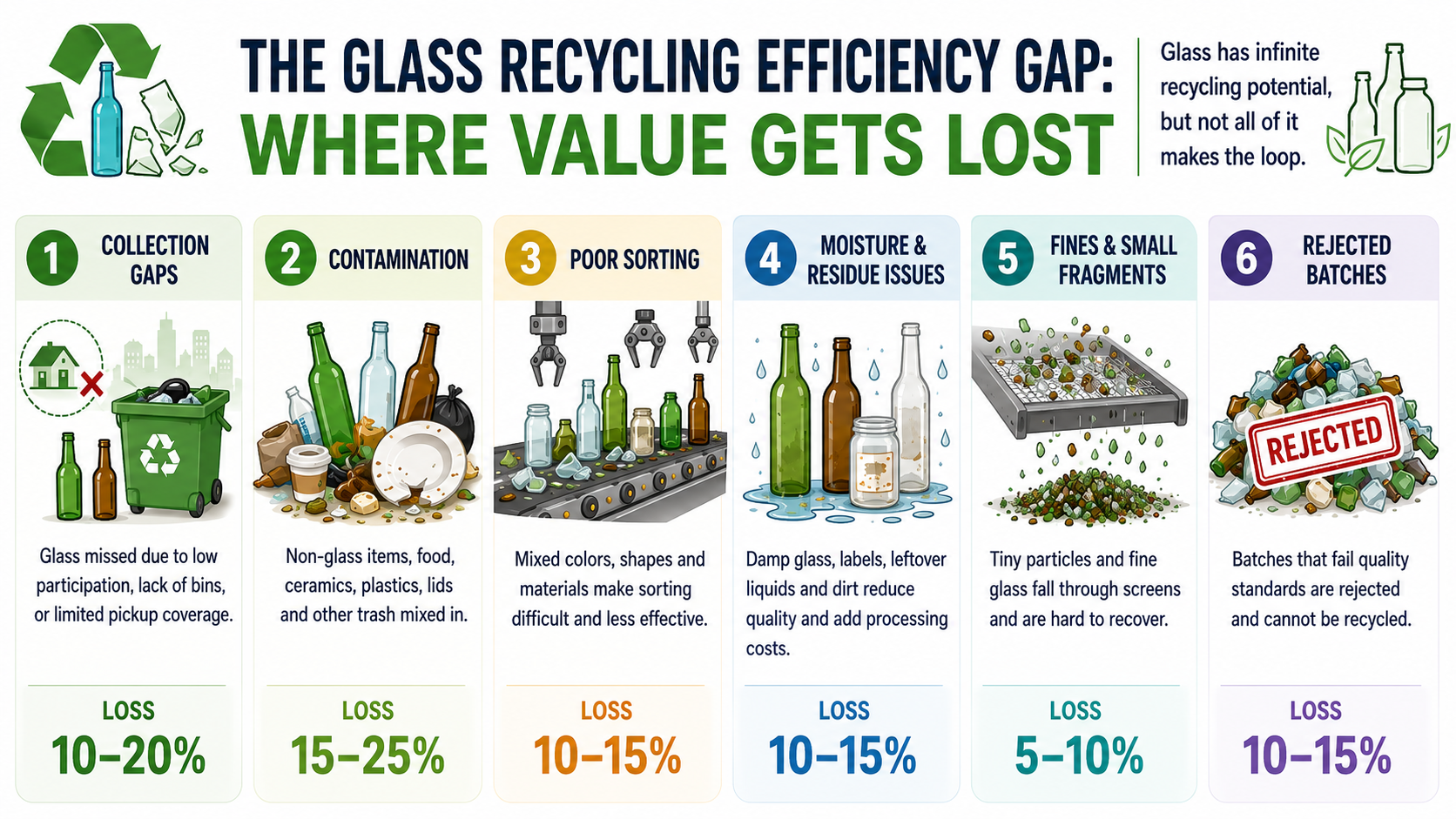
The Glass Recycling Efficiency Gap: Where Value Gets Lost
Glass recycling has strong circular potential, but a large share of value can be lost before the material becomes usable again. Collection gaps, contamination, poor sorting, moisture, fines, and rejected batches all reduce recycling efficiency at different stages. The infographic below highlights where these losses happen and why cleaner, better-managed glass recycling systems matter.
Importance of Innovative Glass Recycling Solutions
Solving the Contamination Crisis
Manually sorting might miss the contamination; to address this, innovative recycling solutions come in. The glass recycling machines use advanced optical sorters, AI-driven detection systems, magnetic separation, and automated cleaning technologies to reduce contamination in recyclable waste streams. These technological advancements in recycling help protect batch rejection, improve material purity, and minimize landfill diversion losses. Therefore, innovative sorting increases the recovery rate of high-value recyclable materials across industries.
Remarkable Carbon Reduction
Innovative processes such as on-site glass crushing can significantly reduce transportation volume by breaking bulky waste glass into smaller, more manageable material. At the same time, converting waste glass into clean cullet helps improve material purity, making it easier to reuse in new glass production. This not only supports better recycling efficiency but also helps lower energy use and carbon dioxide emissions. In fact, according to a study published in the Journal of Industrial Ecology (Westbroek et al., 2021), recycling glass using cullet results in 25–30% furnace energy saving.
Closing the Circular Loop
Australia’s circular economy target depends on recovering more value from waste, not just collecting it. The Australian Bureau of Statistics notes that Australia’s Circular Economy Framework aims to safely recover 80% of resources by 2030, in line with the National Waste Policy Action Plan. Innovative recycling solutions have advanced glass recycling machines, making this possible by improving sorting accuracy, reducing contamination, and converting waste into consistent, reusable raw materials. This helps manufacturers use recycled inputs more confidently and keeps resources circulating instead of going to landfill.
Lowering Processing Costs
Innovative recycling solutions can reduce long-term operating costs by improving automation, reducing manual handling, and minimising material rejection. When waste is sorted more accurately at an early stage, glass waste processing requires less corrective intervention later to manage contamination. Source-level solutions, such as on-site glass crushing, can also reduce storage and transport costs by decreasing waste volume. This makes recycling more practical for businesses that generate large amounts of packaging waste.
Advanced Glass Processing Machines Used in Recycling
Let’s begin by discussing what exactly we mean by advanced glass recycling machines.
Well, these are the integrated industrial systems designed to collect, crush, sort, and refine waste glass into a high-quality cullet, which then can be reused in manufacturing. Here are some vital advanced glass processing machines used in recycling:
1. Crushing Equipment for Glass Recycling
Comec-Crusher
This equipment is designed to crush glass and other materials into small sizes, making it easy for the recycling process. It operates using mechanical compression and impact forces, where glass material is subjected to rotating hammers or compression jaws to get consistent particle sizes to maintain an optimum grain shape, which improves downstream processing efficiency.
Double Roller Crusher
It works by compressing the glass between 2 rotating rollers. Thus, the process enables the production of uniform particles typically in the range of 10-50mm, which is necessary for optical sorting and further refining stages. As the main advantage of a double roller is controlled reduction, it helps to minimize over-crushing and limit dust generation.
2. Glass Screening Equipment
Flip-Flow Screen
Designed particularly for effective screening of difficult-to-screen materials, like sticky or irregular glass fragments. It uses flexible screen mats to prevent clogging and maintains high throughput with low energy consumption.
Circular, Linear, Resonance, and Recycling Screens
To classify crushed glass into different size fractions, these screens are critical to stream each material and process it correctly. While linear screens move the material forward, they are suitable for high-capacity screening. Circular screens use rotating motion to separate coarse and medium fractions. In combination with this, Resonance screens use vibrations tuned close to the machine’s natural frequency, which helps to reduce energy demand.
Elliptical Oscillator Screen
An elliptical oscillator screen is mainly used due to its elliptical motion to improve separation efficiency in compact spaces. It enhances material stratification and ensures accurate grading of fine and coarse particles. This machine is especially useful when the feed contains a mix of heavy glass pieces, fines, paper, labels, and small contaminants.
3. Wet Processing Equipment For Glass Recycling
For glass recycling, washing improves cullet quality before drying and optical sorting. A log washer uses rotating shafts with paddles to scrub the material in water. Next, a bucket wheel is used after washing to recover sand-sized glass particles and separate them from dirty process water. As glass moves through the rotating washing drum, fragments rub against each other while water loosens labels, food residues, dust, and light organic contamination. This processing typically includes:-
- Log Washer
- Bucket Wheel
- Washing Drum
4. Glass Thermal Processing Equipment
Fluidised Bed Dryer
To prevent material degradation and removing the moisture, fluidised bed dryer is essential. This equipment works by passing hot air upward through a perforated plate, causing particles to behave like a fluid. Henceforth, this fluidisation prevents particle clumping or overheating.
Centrifugal Separator
A high-speed rotational speed is needed to separate water from solid particles. For this the centrifugal separator is an essential piece of equipment. During the process, a wet material is spun in a rotating chamber and pushed outward once the centrifugal force expels the moisture.
5. Glass Recycling Sorting Equipment
Optical Recycling Sorting System
Classifying materials based on colour, transparency, composition, and contamination level is done with the help of an optical recycling sorting system. It uses high-speed sensors, near-infrared (NIR) detection, and cameras to identify different types of glass particles on a conveyor belt. The conveyor belt then spreads glass particles into a single, evenly spaced layer for accurate scanning. This highlights conveyor systems revolutionising waste management, which improves sorting efficiency.
Sand Classifying System and Cyclone Air System
This is air-based separation technology used to classify fine glass particles and sand-like fractions after crushing and screening. The system separates particles based on size and density using controlled airflow and vibration, ensuring equal grading of fine materials.
6. Bagging / Palletising of Recycled Glass
The final stage is to weigh, fill, and seal processed glass products such as cullet, glass sand, or graded fine material, supported by the bagging and palletising systems. The bagging system typically feeds material from a hopper into a weighing unit, then fills bags according to a programmed target weight. While the palletising systems automate the stacking of filled bags or packaged materials onto the pallets.
These advanced glass recycling equipments not only improve operational efficiency but also highlight the recycling materials benefits over virgin materials, including reduced raw material extraction, lower energy consumption, and decreased environmental impact.
Conclusion
Improving recycling efficiency requires advanced glass processing technology that streamlines the journey from raw waste to refined aggregate. By automating the most tedious stages of material separation, these glass recycling machines help businesses increase their throughput while maintaining the highest standards of operational safety. If you are looking for a high-performance solution for glass reclamation, OGTEC provides innovative processing systems that guarantee smooth operations and optimised resource management.
OGTEC is a smarter waste solutions provider that powers cleaner, safer, and more efficient commercial operations. Modernise your waste management workflow now!
FAQs
Q1. Why does glass lose value during the recycling process?
Glass loses value when it is not collected properly, gets mixed with non-glass materials, becomes contaminated, or is broken into pieces that are too small to sort and recover efficiently.
Q2. What is the biggest issue in glass recycling efficiency?
Contamination is one of the biggest issues because materials like ceramics, plastics, food residue, lids, and general waste can reduce the quality of the recycled glass and lead to rejected batches.
Q3. Why is sorting important in glass recycling?
Sorting is important because different glass colors and material types need to be separated correctly. Poor sorting can make the glass harder to process and reduce its usability for new glass products.
Q4. How do moisture and residue affect recycled glass?
Moisture, leftover liquids, labels, and dirt can lower the quality of collected glass. This can increase processing costs and make the material less suitable for high-quality recycling.
Q5. What are glass fines in recycling?
Glass fines are very small glass fragments created during collection, crushing, or sorting. These tiny pieces are often harder to recover because they can fall through screening systems or mix with contaminants.
Q6. How can glass recycling efficiency be improved?
Glass recycling efficiency can be improved through better collection systems, cleaner source separation, reduced contamination, improved sorting technology, and proper handling to prevent excessive breakage.