PEF vs. SRF vs. RDF: Understanding the Key Differences and Choosing the Right Recycling Solution for Your Facility

Did you know Australian businesses generate over 7.4 million tonnes of waste annually? Most of it- plastics, packaging, textiles, and more- ends up in landfills or incinerators (ABS). However, as the Australian Government aims towards a Circular Economy by 2030, recycling has become a crucial component of sustainable waste management. For many facilities, this means exploring advanced recovery methods, such as Refuse-Derived Fuel (RDF) recycling, Solid Recovered Fuel (SRF), and Processed Engineered Fuel (PEF). While all three methods are part of modern recycling, they differ in several key parameters. In this article, we’ll discuss what makes each of them unique and help you choose the most efficient solution for your facility.
Recovered Fuel Solutions Explained ClearlyRDF, SRF, and PEF offer distinct approaches to converting non-recyclable waste into useful energy. RDF involves basic processing and variable fuel quality, while SRF provides greater consistency through refined treatment. PEF undergoes advanced sorting, drying, and optimisation for demanding industrial applications. Choosing the right option depends on waste composition, energy requirements, infrastructure, regulatory obligations, storage needs, and sustainability goals, helping facilities reduce landfill reliance and fossil fuel consumption. |
What Are RDF, SRF, And PEF
Refuse-Derived Fuel (RDF): It is a partially processed fuel generated from mixed municipal solid waste (MSW) or commercial and industrial (C&I) waste. It includes plastics, textiles, paper, cardboard, and wood. In many cases, these materials originate from skip bin recycling streams where residual waste is sorted for recovery. RDF is typically created through mechanical sorting and basic shredding, but it doesn’t always undergo rigorous quality control. This results in a product that has variable composition and calorific value, making it more suitable for low-efficiency incineration or basic waste-to-energy (WtE) plants. RDF is often used in pilot projects or in regions where high-end infrastructure is not yet in place.
Solid Recovered Fuel (SRF): SRF is a way more refined and consistent alternative to RDF. It is produced through mechanical-biological treatment (MBT), followed by drying, screening, and granulation, which ensures fewer contaminants and more predictable fuel characteristics. In Australia, it is aligned with European standards (CEN/TC 343), ensuring it meets strict criteria for energy content, particle size, and emissions. This makes SRF recycling ideal for use in cement kilns, lime plants, and other co-incineration facilities where fuel performance and environmental compliance are critical. Even leading building materials companies are incorporating SRF into their fuel mix to lower carbon footprints and comply with evolving environmental standards.
Processed Engineered Fuel (PEF): PEF recycling is the most advanced and efficient option, made from non-recyclable dry waste that undergoes intensive sorting, decontamination, and drying. It is often pelletised for improved transport and combustion. Designed for specific industrial applications, PEF ensures a consistent calorific value and minimal emissions, making it ideal for high-performance combustion systems, such as those used in cement manufacturing, steel production, and large industrial boilers. In Australia’s decarbonisation drive, advanced recycling sorting systems are supporting the production of cleaner fuels, such as PEF, positioning it as a preferred alternative to fossil fuels.
Unlock smarter waste recovery with advanced solutions that transform residual materials into valuable, energy-rich fuels. |
From Residual Waste to Recovered Fuel
Residual waste can undergo a series of controlled processes before becoming a usable recovered fuel. First, incoming materials are sorted to remove recyclable, hazardous, and unsuitable items. Combustible materials such as plastics, paper, textiles, and wood are then separated and prepared for further treatment. Depending on the required fuel specification, processing may include shredding, screening, drying, decontamination, and size reduction. Quality checks help control moisture, contaminants, particle size, and energy content. The resulting fuel can then be prepared for transport and supplied to suitable industrial energy-recovery applications.
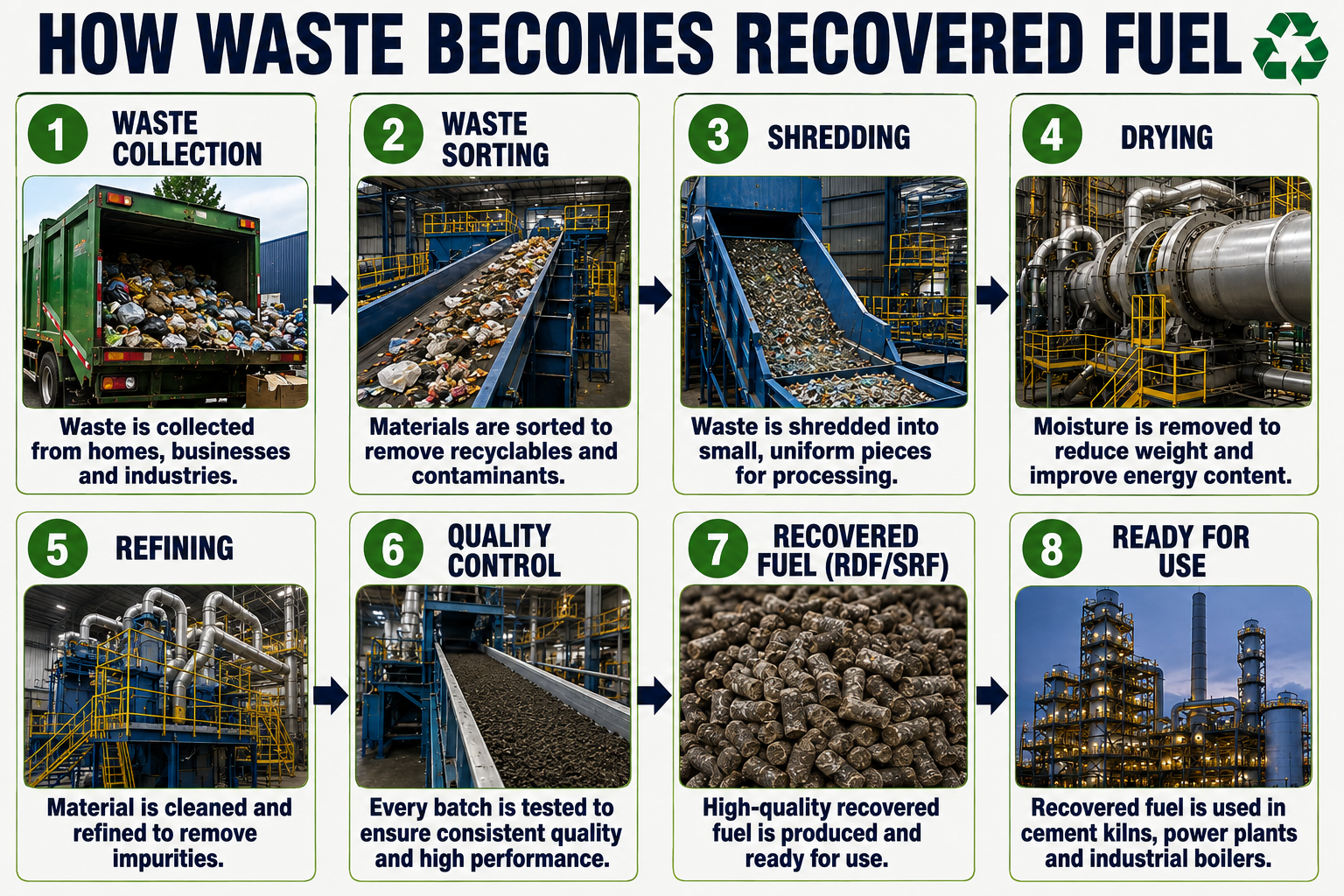
Key Differences Between PEF, SRF, and RDF
Criteria | RDF | SRF | PEF |
Type of waste | Municipal and C&I waste. | Clean fractions from commercial or industrial non-recyclables. | Carefully selected and sorted non-recyclables. |
Moisture Content | 20–30% | 10–15% | <10% |
Processing Complexity | Basic sorting and shredding | Mechanical-biological treatment (MBT) with refining | High-tech treatment with fuel property optimisation |
End Use | Incinerators, low-tech energy recovery units | Cement kilns, co-firing in industrial furnaces | Cement kilns, lime plants, industrial thermal applications |
Emission Control | High variability | Lower emissions due to cleaner input | Optimised for low NOx, SO₂, and particulate matter |
Transport & Storage | Bulky and unstable | Pelletised or compacted; more stable | Pelletised or baled; high storage efficiency |
Cost efficiency | Cheapest to produce, lowest energy output | Moderately cost-effective with higher performance | More expensive but offers the best energy-to-cost ratio |
Choosing the Right Solution for Your Facility
Understand Your Waste Composition
Start with a detailed waste audit to identify material types, moisture, ash, contaminants, and potential energy value. Research published in Environmental Science & Technology found that plastics, textiles, and rubber can significantly influence SRF quality and contaminant levels. The Australian Government’s DCCEEW also identifies timber, plastics, paper, cardboard, and textiles as key feedstocks for specification-based recovered fuels. This assessment helps determine the most suitable fuel pathway for your facility.
Evaluate Your Energy Needs
If your facility operates high-energy-intensive machinery (e.g., cement kilns and steel plants), PEF can provide a cleaner, high-calorific alternative to fossil fuels. For medium-level energy needs, SRF offers a good balance between quality and cost. In comparison, RDF is typically suitable for lower-tech incineration systems.
Australian cement manufacturers using SRF/PEF have reported a 25–30% reduction in fossil fuel dependency, according to Cement Industry Federation data (2023). |
Assess Infrastructure Compatibility
Check whether your facility is compatible with implementing these recycling solutions. For instance,
- RDF requires minimal pre-treatment and is compatible with existing incinerators.
- SRF may require specific burners or co-incineration equipment.
- PEF is typically used in facilities with advanced combustion technology.
Meet Sustainability and Compliance Targets
With growing ESG expectations and regulatory scrutiny, SRF and PEF can support Australia’s resource-recovery and circular-economy objectives. The Australian Government’s DCCEEW reports that Australia recovered 66% of resources from total waste generated in 2022–23, compared with 61% in 2016–17. Australia’s 2024 National Waste Policy Action Plan targets an 80% average resource recovery rate by 2030, highlighting the need for stronger recovery pathways.
Conclusion
Waste generation continues to rise across Australia, putting constant pressure on businesses to adopt smarter and more sustainable waste management practices. Therefore, implementing effective measures is no longer optional; it is essential. Ready to explore the future of sustainable waste and recycling solutions and take the next step toward a circular economy? Visit OGTEC, one of Australia’s leading providers of waste and recycling capital equipment, offering advanced solutions for sorting, resource recovery, and fuel conversion.
Turn your waste streams into valuable resources with tailored recycling solutions designed to improve recovery, efficiency, and sustainability. |
PEF vs. SRF vs. RDF: Frequently Asked Questions
Q1. Is RDF, SRF, or PEF suitable for small businesses?
Yes, smaller facilities can use recovered fuels through suitable waste processors, provided their waste volumes, collection arrangements, storage capacity, and nearby end users support the solution.
Q2. How is the quality of recovered fuel tested?
Recovered fuel quality is assessed through laboratory testing for parameters such as calorific value, moisture, ash, chlorine, heavy metals, particle size, and other contaminants.
Q3. Can recycled fuel be made from construction and demolition waste?
Certain combustible materials from construction and demolition waste can contribute to recovered fuels after appropriate sorting, contamination removal, and processing, depending on local requirements.
Q4. What happens to waste that cannot become RDF, SRF, or PEF?
Non-combustible or unsuitable materials may be directed toward recycling, specialised treatment, landfill, or other approved disposal pathways based on their composition and contamination levels.
Q5. Can recovered fuels replace coal or other fossil fuels completely?
Complete replacement depends on the facility, combustion technology, fuel specifications, operational requirements, and regulatory approvals. Many facilities instead use recovered fuels as partial substitutes.