Difference Between Single-Deck vs Multi-Deck Vibrating Screens
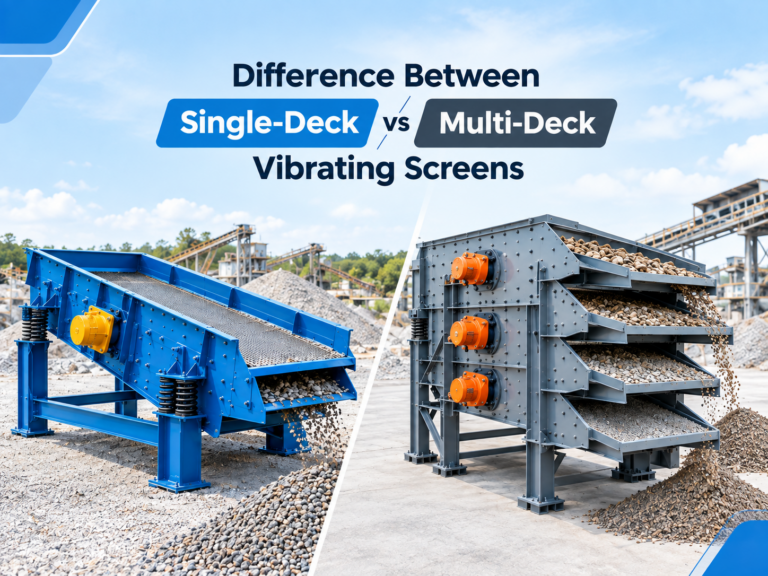
Vibrating screens are the backbone of material separation across mining, aggregate, recycling, and processing industries, sorting bulk materials into precise size fractions with speed and accuracy. Yet not all vibrating screens are built the same. One of the most fundamental decisions engineers and plant managers face is choosing between single-deck and multi-deck configurations, which directly impacts screening efficiency, throughput capacity, and long-term operational costs. While single-deck vibrating screens offer simplicity and ease of maintenance, multi-deck systems provide multiple gradations in a single pass, making them ideal for demanding operations. Thus, understanding these differences is essential for selecting equipment that aligns with your specific production goals. In this guide, we’ll break down how each design works, their respective advantages, and which applications suit them best.
Single and Multi-Deck Vibrating Screens: OverviewSingle-deck vibrating screens provide a simple, cost-effective solution for single-size separation, scalping, de-dusting, and safety screening, with easier maintenance and access. Multi-deck vibrating screens use stacked screening surfaces to produce multiple particle-size fractions in one pass, making them suitable for higher classification demands. Choosing between them depends on material characteristics, required separation, throughput, operating conditions, and maintenance considerations, ensuring the screening configuration matches specific processing and production requirements. |
What are the Single-Deck and Multi-Deck Vibrating Screens
Single-Deck Vibrating Screens
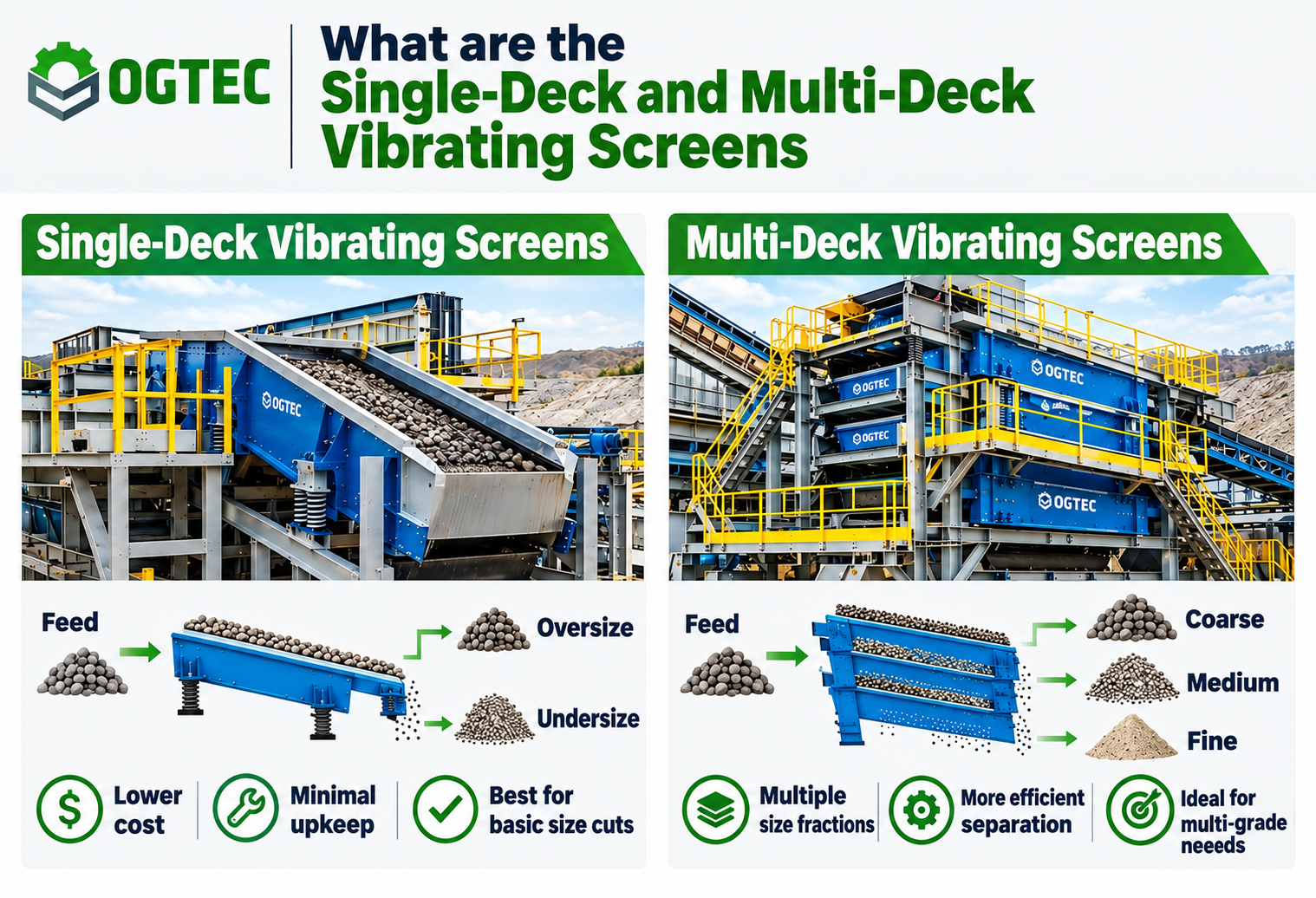
As the name suggests, these screens use a single screening surface inside the vibrating frame. Material passes over it and gets split into two groups: the bigger pieces (oversize) stay on top, while the smaller ones (undersize) fall through. As there’s only one layer of screening, this setup works best when you need a basic size cut, without added complexity, at a lower cost, and with minimal upkeep. This makes them useful across applications involving different industrial waste streams, where a straightforward separation is required before further processing.
Multi-Deck Vibrating Screens
These take things a step further by stacking two or more screening surfaces within the same frame. As material moves through, each deck fitted with progressively finer mesh sorts it into a different size category, all in a single run. This means you get multiple size fractions at once. Multi-deck vibrating screens are the go-to choice for operations that need to separate materials into several grades simultaneously. In recycling facilities, this type of classification can be particularly useful when processing mixed materials described across different industrial waste recycling types, where several particle-size ranges need to be recovered from one feed.
Vibrating screens are well suited to many waste and recycling separation requirements. For facilities that need to combine different screening stages within a broader processing line, a Trommel screen for waste management may also complement the screening process where the feed characteristics and processing objectives suit rotary screening.
Not sure which screening configuration fits your material and production requirements? OGTEC can assess your application, throughput, screening requirements, and duty cycle to develop a screening solution suited to your operation. |
Single-Deck vs Multi-Deck Vibrating Screens
Choosing the right deck configuration can simplify material handling by matching screening stages to the required separation. As technological advancements in recycling continue to improve processing operations, understanding these differences helps facilities make informed equipment decisions. Hence, the table below offers you a clearer comparison of how each vibrating screen works.
Comparison Factor | Single-Deck Vibrating Screen | Multi-Deck Vibrating Screen |
Screen arrangement | All material travels across a single screen surface, giving the machine one continuous screening path. | Screening surfaces are stacked vertically, with the upper deck generally handling the coarser cut and lower decks making progressively finer separations. |
Particle-size classification | These vibrating screens work well when the process needs a simple coarse/fine split, such as removing oversize material before a downstream operation. | It allows several particle-size ranges to be produced in a single screening pass, making it practical for multi-grade classification. |
Typical product streams | One cut point results in two product streams: material retained above the aperture and material passing through it. | Usually, a multi-deck screen allows a two-deck arrangement to give three fractions; a three-deck screen can produce four fractions, depending on the discharge arrangement. |
Scalping requirement | Well suited when the objective is simply to remove oversize lumps before crushing or another downstream process. | Can combine scalping with additional classification, but the extra decks are unnecessary when oversize removal is the only required separation. |
Classification sequence | The feed undergoes its entire separation on the same screen surface, so there is no second classification stage within the machine. | Separation occurs progressively: the upper deck handles the coarse cut, material passing through moves to the next deck, and lower decks make finer cuts. |
Best-fit application | This vibrating screen is particularly appropriate for scalping, safety screening, de-dusting, or single-grade classification, where one separation is sufficient. | It is better suited to processes that require multiple product grades or simultaneous coarse, intermediate, and fine separation from one feed stream. |
Maintenance access | The single screening surface is generally easier to reach for routine inspection, cleaning, tension checks, and screen-media replacement. With fewer deck components, technicians can typically access the screening surface without working around additional upper decks. | The inspection and replacement may require side access, removable panels, lifting equipment, or additional clearance designed into the machine. |
Conclusion
When you need a screening solution built around your operation, OGTEC provides a single team to simplify the process from planning to installation. Our engineers consider material type, throughput, screening requirements, and duty cycle when developing fit-for-purpose solutions. We provide process development, plant design, project management, plant upgrades, turnkey plants, manufacturing, and installation, helping you coordinate equipment selection and implementation through one experienced resource for waste and recycling applications.
If you are looking to plan a new recycling facility or upgrade an existing processing line, you get a straightforward solution with Us. OGTEC can take your project from process development and plant layout through custom manufacturing, installation, and commissioning. |
FAQs About Single-Deck vs Multi-Deck Vibrating Screens
Q1. What factors affect vibrating screen efficiency?
Screen inclination, vibration frequency, amplitude, feed rate, aperture size, material properties, moisture, and screen length can significantly affect separation performance.
Q2. Why is screen inclination important?
Inclination changes particle travel speed and residence time; excessive inclination can shorten screening time and reduce opportunities for particles to pass through openings.
Q3. How does screen media affect separation accuracy?
Aperture geometry, open area, and media condition influence particle passage, while worn or damaged media can alter the intended separation characteristics.
Q4. What causes pegging on a vibrating screen?
Pegging occurs when particles close to the aperture size become lodged inside openings, progressively restricting the available screening area.
Q5. Can vibrating screens handle wet or sticky materials?
Yes, but wet or sticky feeds may require appropriate screen media, cleaning methods, and operating adjustments to prevent blinding and maintain a usable screening area.