Why Double Shaft Shredders Are Ideal for Heavy-Duty Industrial Waste
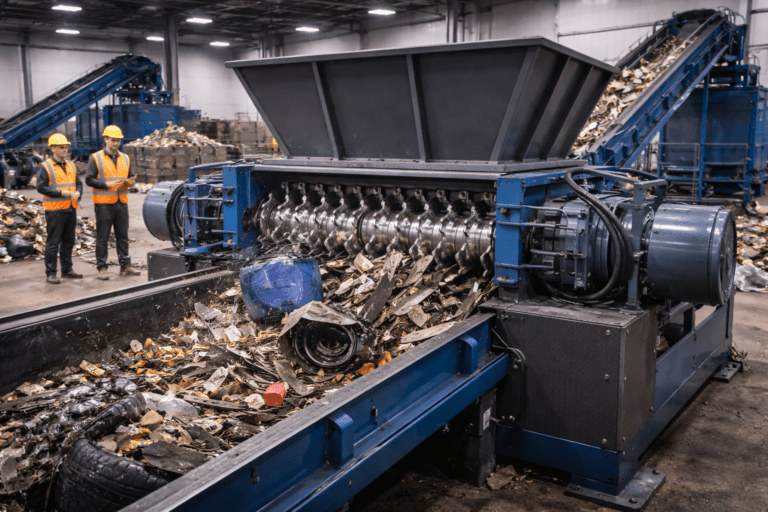
Every industrial facility hits the same wall: waste that’s too thick, too dense, or too unpredictable for standard shredding equipment. In such situations, single-shaft shredders jam, compactors skip materials, and annual sorting ends up wasting labour hours. On top of this, the operational cost of inefficient waste processing quietly drains budgets every single day.
This is where double shaft shredders come in and fix these issues at the root. With dual counter-rotating shafts and high torque capacity, they process materials other machines can’t touch. To get an even better understanding of why double shaft shredders are the go-to solution for heavy-duty waste management, we bring you this blog that highlights the mechanical edge they hold over alternatives and why more industrial facilities are making the switch.
Key Highlights: Double Shaft Shredders for Complex Waste StreamsThis blog explains why double shaft shredders are increasingly used in heavy-duty industrial waste management. It highlights how these machines support consistent processing across unpredictable, high-load waste streams without frequent interruptions. The focus is on improving operational efficiency, reducing unplanned downtime, and enabling smoother primary waste reduction. For industrial facilities, they represent a more reliable approach to handling complex waste at scale. |
What Are The Challenges With Industrial Waste Management?
Materials That Wrap and Jam
Plastic film, fishing nets, rubber sheets, and industrial textiles stretch and twist around the rotor until the machine seizes or the material melts. No speed adjustment fixes this because nothing mechanically opposes the rotor. This limitation is common across several industrial shredder types. What’s needed is a cutting mechanism that actively works against the material’s tendency to wrap.
Waste Where You Don’t Know What’s Coming
Construction debris and municipal solid waste (MSW) don’t arrive sorted. Buried bolts, stone chunks, and dense scrap metal are a given on any shift, making them among the most common construction and demolition waste challenges in high-volume processing. The machine itself needs to handle unexpected resistance without transferring that force into the blades or gearbox.
Wet and Sticky Waste
Single-shaft machines use a screen mesh to control output size. In wet or sludge-heavy waste, the screen clogs, material backs up, and the machine stops, that too repeatedly across a shift. Any machine handling high-moisture waste needs to control output size without depending on a component that the material itself will disable.
Composite and Multi-Material Waste
Car seats with embedded metal frames, circuit boards, and laminated panels all require pre-sorting before most shredders can handle them without blade damage. In a high-volume facility, pre-processing consumes hours every shift. The machine needs to handle material separation and size reduction in the same pass.
Raw Bulk Waste at the Primary Stage
Quad shaft shredders and granulators are engineered for pre-reduced, clean feedstock. Running raw bulk industrial waste through them accelerates blade wear and drives up cost per tonne. Primary reduction needs a machine built around irregular, oversized, unpredictable input as the baseline , and not the exception.
Why Dual Shaft Shredders Work Best for Heavy Duty Industrial Waste Disposal?
Every problem in the previous section comes down to a machine hitting a design limit. Modern waste management trends in recycling equipment increasingly prioritise equipment that can handle high loads and continuous operation. This is where double shaft shredders are engineered differently:
Independent Dual Drive via Planetary Gearboxes
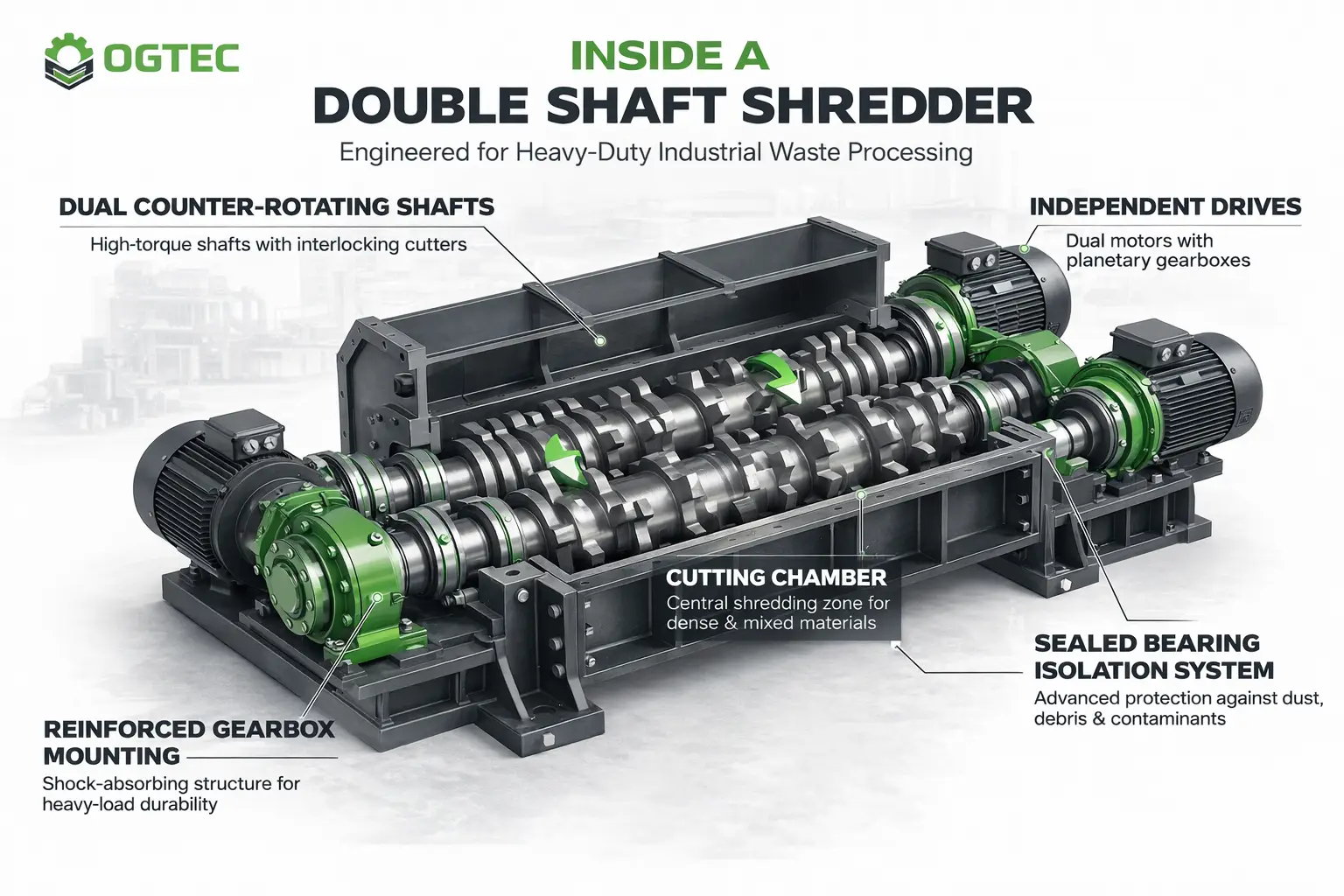
Each shaft in a dual shaft shredder runs on its own motor and planetary gear reducer independently. When one shaft hits resistance, the other keeps running. On a single motor machine, the entire system stalls. This is what makes dual shaft machines viable for continuous heavy industrial operation across full shifts.
Output Size Influenced by Blade Thickness, Not a Screen
Because there is no screen, the output particle size is influenced by blade thickness and shaft spacing rather than a mesh that degrades over time. The tradeoff is that output is less uniform than screen-based machines, but the operational advantage is that there is no screen to clog, replace, or service mid-shift. For heavy industrial waste where throughput consistency matters more than particle precision, this is the right tradeoff.
Blade Geometry Customisable Per Material Type
Hook cutters in double shaft industrial shredders are designed for maximum penetration and pulling large hollow objects in. Four-tooth cutters handle general mixed industrial scrap with a balanced ratio of grabbing and tearing. Denser tooth layouts handle thin films and flexible materials that wrap. These are hardware-level configurations that change what the machine can process without replacing the entire unit.
Shock-Absorbing Gearbox Mounting
Dense industrial scrap hitting the cutting chamber creates sudden, sharp load spikes. The gearbox mounting system in a double shaft machine is specifically engineered to absorb these rather than transfer them directly into the drive components. This is why dual shaft machines maintain predictable maintenance intervals even with unpredictable waste streams.
Sealed Bearing Isolation From the Cutting Chamber
This machine features a false-wall chamber with an air gap, steel interlocking labyrinth shields, and composite lip seals that physically separate the bearing assemblies from the processed material. In heavy industrial environments where fine metal dust, silica, and chemical residue are routine, this multi-layered isolation is what keeps bearing failure off the maintenance schedule. Thus, this machine strengthens material recovery outcomes, allowing facilities to capitalise on the benefits of recycling materials over virgin materials at scale.
Conclusion
Mapping your input conditions against the mechanical limitations covered here will tell you whether a double shaft configuration is the right move for your facility. And if it is, the best place to get it is OGTEC! Our team of engineers designs customised solutions around your specific waste stream, available space, and operational requirements, not a one-size-fits-all spec sheet. So, are you ready to stop absorbing the cost of the wrong machine? Get in touch with OGTEC!
FAQs
How reliable are double shaft shredders for round-the-clock industrial use?
They’re built for continuous operation, but performance depends on proper sizing, cooling, and load handling for your specific waste stream.
Which industries see the most value from double shaft shredders?
Industries handling mixed, bulky, or unpredictable waste, like C&D, metals, MSW, and e-waste, typically benefit the most.
Can a double shaft shredder fit into an existing processing line?
In most cases, yes, it can be integrated with conveyors and sorting systems with proper planning and control alignment.
How much power do double shaft industrial shredders consume?
Energy use varies by material and load, so evaluating power per ton processed gives a clearer picture than total consumption.
Can a double shaft shredder handle tangled materials like cables or ropes continuously?
Yes, the dual shaft action helps pull and break tangled materials instead of letting them wrap and stall the system.