How Tyre Shredding Streamlines Industrial Waste Management?

With time, it has started to get very difficult for industrial waste systems to manage end-of-life tyres. If not mechanically processed, their large size, reinforced construction and poor biodegradability render transportation, storage and disposal ineffective. The most concerning part is that there are over 100 million tyres in circulation in Australia, with just 68 million (according to Tyre Stewardship Australia) reaching end-of-life annually. And that’s placing growing pressure on waste infrastructure and treatment capacity.
Tyre shredding is an important step in industrial waste management systems that helps deal with this growing problem. It turns whole tyres into standardised, process-ready feedstock by using controlled mechanical size reduction.
Curious to know more about tyre shredding? In this blog post, we will discuss how the process works and the key benefits it delivers for streamlining industrial waste management and improving sustainable material recovery.
What is Tyre Shredding? How Does It Work?
Tyre shredding is one of the top commercial and industrial waste management solutions. It is a mechanical size reduction process that converts whole end-of-life tyres into smaller, uniform fragments suitable for downstream recycling, recovery, or energy-use applications. This process of shredding uses high-torque, low-speed or high-speed industrial tyre shredders that are specifically designed to handle reinforced rubber structures containing steel belts and textile fibres. It breaks tyres into controlled particle sizes, reduces volume, improves material handling efficiency, and prepares the waste stream for further separation or processing.
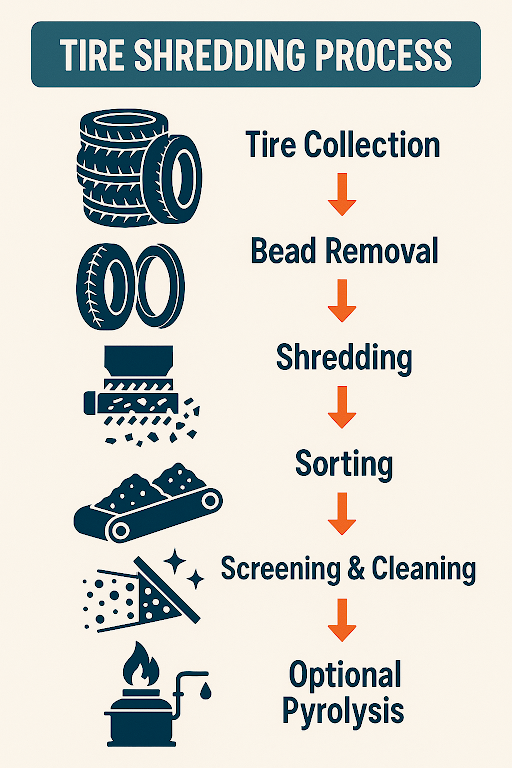
Here’s how the process works:
- Tire Collection: First, scrap tyres are collected from dealerships, service centres, and collection points and then transported to recycling facilities.
- Bead Removal: Then the steel-reinforced tyre beads are removed using specialised machines to protect shredders and recover valuable steel for recycling.
- Shredding:Tyres are mechanically or cryogenically shredded into uniform chips, crumb rubber, or granules. It’s suitable for products like tyre-derived fuel, rubberised asphalt, playground surfaces, and moulded goods. This step is typically performed using a high-capacity industrial tyre shredder for maximum efficiency.
- Sorting:Then, using magnetic and air-based separation systems, professionals extract steel and textile fibres from rubber, ensuring contaminant-free material.
- Screening & Cleaning: After careful sorting, shredded rubber is classified by size and cleaned to meet industrial standards.
- Optional Pyrolysis:Advanced facilities convert shredded tyres into pyrolysis oil, carbon black, steel, and synthetic gas for energy and industrial use.
Benefits of Tyre Shredding in Industrial Waste Management
1. Bulk Density Reduction and Waste Stream Conditioning
End-of-life tyres (ELTs) offer low bulk density, high elasticity, and geometric rigidity, which makes them unsuitable for efficient storage or disposal. Tyre shredding performs controlled mechanical comminution that converts whole tyres into uniformly sized fragments that significantly increase bulk density. This conditioning of the waste stream enables compact storage, conveyorised handling, and compatibility with downstream processing tyre shredding equipment, forming a core component of integrated waste & recycling solutions.
2. Process Integration and Material Flow Optimisation
Shredded tyre material is flow-stable and dimensionally consistent, ensuring easy integration with industrial material-handling systems such as automated dosing units, belt conveyors, screw feeders, and surge bins. As particle size decreases, it enables continuous, high-throughput operation while reducing bridging, clogging, and handling interruptions.
3. High-Efficiency Component Liberation and Separation
Tyre shredding is essential for liberating embedded steel reinforcement and textile fibres from vulcanised rubber matrices. With precision tyre shredding equipment, controlled particle sizing improves the performance of magnetic separators, eddy current systems, air classifiers, and gravity-based separation units. This results in high-purity recovery of ferrous metals for scrap recycling and clean rubber fractions suitable for secondary processing
4. Fire Risk Suppression and Operational Hazard Mitigation
Whole tyre stockpiles can trap air, retain heat, and have high hydrocarbon content, presenting an elevated fire risk. Shredding disrupts tyre geometry, eliminating internal voids and reducing the potential for sustained combustion. Smaller fragments dissipate heat more efficiently and are easier to manage in controlled storage environments, significantly lowering fire propagation risk and improving site safety.
5. Regulatory Conformance and Environmental Control
Tyre shredding supports compliance with waste management regulations that prohibit uncontrolled stockpiling and landfilling of whole tyres. Processed tyre material enables traceable, controlled recycling streams, reduces leachate formation, prevents standing water accumulation, and directly addresses environmental pollution risks associated with waste tyres.
Conclusion
The increasing number of tyres thrown away in Australia highlights the need for scalable, dependable, and compliant waste and tyre recycling solutions. That is why tyre shredding with a high performance industrial tyre shredder comes off as a great approach that promotes recycling and reuse. It even lessens the amount of waste dumped in landfills, and enhances long-term environmental results, so sustainable too! Additionally, using it as part of an integrated processing system enables businesses and local governments to shift from disposal-based waste management strategies to more environmentally friendly, recovery-focused ones.
FAQs
Is it possible to recycle or reuse shredded tyres?
Yes. Many industries can easily reuse and recycle shredded tyres. You can make a lot of different things from the processed material, such as crumb rubber, aggregate made from tyres, or fuel made from tyres. They can even be used in road building, civil engineering, energy recovery systems, and making rubber, which all support the reuse of materials in a circle.
What type of tyres can be shredded?
Most of the tyres can easily be shredded. Some include passenger car tyres, truck and bus tyres, off-the-road (OTR) tyres, agricultural tyres, and industrial tyres. Modern shredding systems handle reinforced rubber structures containing steel belts and textile fibres, which helps in a safe and efficient processing across tyre categories.
Is shredding tyres a good idea for big industrial operations?
Yes. Tyre shredding systems are made to work continuously and at a high rate of throughput. They can also be scaled up to handle large amounts of tyres efficiently. Shredders are good for commercial and municipal waste management facilities because they can be used in industrial processing lines to automate handling, ensure consistent output quality, and ensure reliable performance.
What happens to the steel and textile parts after they are shredded?
When shredding, magnetic and air-based systems are used to separate steel and textile reinforcements. Scrap metal channels are used to recycle recovered steel, and textile fibres can be processed for other uses or to get energy back. This separation makes the materials cleaner and makes the most of the efficiency of resource recovery.